A moment of reflection

Screen Shot 2017-03-15 at 9.15.42 PM

Sometimes you need a reason to look back and reflect on the past.

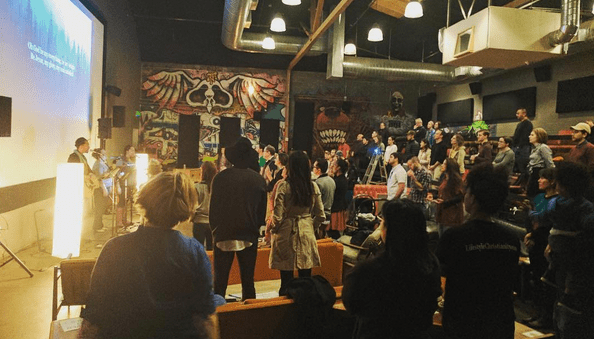
This week I was asked to write a quick update for a church in LA (Northland Village Church, NVC ) that supported Oak Life before we started.  I interned at NVC while at seminary and our time there was incredibly formative as we prepared for planting a new church.  As I typed the brief 5 sentences I found myself getting really sentimental and overwhelmed with all that’s happened in the last few years.  It’s amazing that not too long ago Oak Life didn’t even exist, that I hadn’t yet met some of the folks that have become some of my closest friends, and the countless stories of life change that have come from our community hadn’t been written yet.  Especially in times as divided as today, the importance of  communities like ours who are about of reconciliation, peace, and justice, has become increasingly clear. I’m so humbled to get a front row seat to the Oak Life story and I can’t wait to see what’s next.

Here’s the quick update I wrote for our friends down at NVC and below that a note written to Oak Life after election day 2016:

“This October Oak Life Church turned two years old and what a ride it’s been. Our story has centered on the metaphor of a tree that has roots and branches- going deep together and going out together.  Being a church in Oakland, California, we’ve found ourselves at the intersection of numerous social justice conversations and have had the opportunity to join in on good work in areas like homelessness, racial reconciliation, LGBTQ equity, creation care, and more.  One of the most encouraging patterns in our short history is that people, especially folks who have been hurt by the church or have never fit in at church, consistently describe our community as a safe place to explore Christianity.  Over the past few years we’ve been amazed by stories of new life that keep happening as we’ve gone from a group of 7 people in an apartment to a theater filled with almost 100 people doing life together.   Thank you for your support and partnership with what God is doing here in Oakland, without churches and communities like yours, none of this would have happened.”

—-
“Oak Life Church,

You are more needed than ever.

Your inclusive, thoughtful, sincere, welcoming, and grace-oriented spirit has the power to heal and reconcile more than you probably know.

While so many have taken the the label ‘Christian’ and tangled it with fear based politics and the the exploitative ambition for power, you’ve stayed compassionate, open, humble, and embracing of those on the margins.

Though you are not polished, though you are still young, and you can’t yet pay your own bills,

You are beautifully walking the messy path of love in a world that all to often defaults to ethnocentrism, exclusivity, judgement, and rejection of the “other”.

You are gritty, eclectic, honest, and diverse.

You are the antidote to religious expressions that are more concerned with the comfort of the majority, the building of institutions, and the vice of nationalism than concern for the poor, commitment to justice, or openness to mystery.

I have seen the potential of our community, and I’m more convinced than ever that what is being formed in our midst is urgently needed in our world.

You are a new wineskin, the rays of light shinning from a fresh sunrise on a broken, divided, and tired land.

You are a vessel of peace, a place of safety, and the very body of God incarnate- the hands and feet of Christ.

Your branches provide perch and shade for the lost, wounded, and weary.

And your roots offer nourishment to hungry souls.

Keep going.

Keep asking the tough questions.

Keep believing that our faith is strong enough for doubts.

Keep loving the outsider.

Keep loving your enemies.

Keep praying for peace.

Keep entering into the pain others.

Keep allowing the Spirit of God to breath life into you.

Don’t grow weary.

Get involved.

If you’re frustrated by the church, let’s build something new.

Let’s keep this thing going. Let’s write history.

Let’s show the world what what Christ’s love looks like.”


Book Review: Junkyard Wisdom

junkyard-wisdom.jpg

When I was a teenager I had the unique privilege of traveling with my church youth group to rural Belize on a Summer service trip.  We visited a village called Armenia and stayed at a center called Jaguar Creek, which I later learned was one of the first Christian environmental preserves.  Our group’s aim was to serve and learn from the locals as well as gain a global perspective.  For a high school student on Summer break, it was quite an adventure.  I can vividly recall the long, hot days constructing a playground in an impoverished community, the overwhelming experience of exploring the rainforest, and the once in a lifetime chance to be on the receiving end of insanely generous hospitality during a two night home-stay with a Mayan family.  As I look back on my life’s trajectory, I’m convinced that being exposed to the people, poverty, and perspectives of Belize was one of the most formative experiences of my youth, especially for my young faith.

As incredible as our trip to Belize was, I still remember the challenge of coming home and realizing that I was rich.  While I went back to my “normal” life filled with instant access to food, shelter, education, healthcare, technology, and entertainment, our new friends back in Belize would still struggle.  Why do I live here, and they live there?  What does it mean for me as a Christian to be considered rich by global standards?   What’s my role in helping the poor? 

The tension of these questions has remained with me ever since.

The organization that facilitated and hosted our group was founded and overseen by a guy named Roy Goble, who I’ve been fortunate enough to learn from and become friends with over the subsequent years since my first trip to Belize.  If you know Roy you might know a few things about him:  he’s wealthy, he’s deeply involved in social justice and philanthropy, and he’s a Christ follower.  Roy’s work is one of paradox.  Some days he may find himself making real estate deals with other millionaires, and other days he’s walking the streets of a slum in the developing world.  Roy lives in the tension, and has been wrestling with what it means to be a rich Christian called to love the poor for his entire adult life.   That’s why I was super excited to learn that he would be writing a book that wrestles with these very issues in depth.

I first learned about the book that would later become Junkyard Wisdom: Resisting the Whisper of Wealth in a World of Broken Parts, when talking with Roy about our work in Myanmar.   As a respected non-profit and business leader, I had reached out to Roy to pick his brain with regards to starting our own non-profit, Bridges Myanmar, a 501c3 that works to alleviate poverty through education.  He was extremely helpful, generous, and supportive of our vision.  So a few years later when Roy asked if he could travel with us to Myanmar, I was ecstatic.   I not only looked up to him for both his experience and accomplishments, but it was in part because of his work in Belize that my worldview and faith developed a concern for global poverty and injustice, so having him as our guest in Myanmar was a no brainer.  (Not to be too braggadocious, but Roy’s time in Myanmar made it into the book!) Also, Roy has a dry, sarcastic, and sometimes cynical sense of humor that would pair well with a good scotch and inappropriate jokes.  Those are all things I like.

Junkyard Wisdom is essentially a series of stories and reflections surrounding the tension of being rich (which includes pretty much anyone living in the global north), being connected to the poor, and being a Christian.   Through numerous compelling stories, Roy takes his readers around the globe as he explores the often uncomfortable realities of poverty and wealth.  Roy is honest with his questions and authentic with his conclusions.

One of my favorite sections of the book is when Roy considers whether or not he is called to “sell his possessions and live with the poor”.   Using Shane Claiborne as an example, a guy who lives in inner city Philadelphia among the poor, Roy describes the lifestyle of radical simplicity and service.  As he wrestles with the idealism of this potential pathway, Roy points out that giving everything away, though seemingly noble, would actually be the easy way out.  He concludes that for him, he’s called to live in the tension, by being in relationship with the poor, and leveraging his wealth for maximum impact in the world.  The best part was a footnote left by Shane which illustrates the tension:

“Hey, this is Shane Claiborne. Roy gave me this book to read, and it’s true:  God doesn’t call everyone to sell everything and move to the inner city or some foreign country.  Or even to have dreadlocks like I do.  For the record, I don’t think God is calling Roy to sell his business and give everything away.  But that’s not say that he won’t someday.  Careful, Roy!” (56)

Here we see the type of tension that Roy invites his reader into, one that wrestles and questions, and remains open.  Though he’s concluded that his role is to steward his wealth for the greatest good, he leaves space for possibility that God might someday still call him to sell it all.  This is probably the main idea of the book, or at least the one I was left with- that when it comes to wealth, poverty , and the way of Christ, we can’t get comfortable.  We must ask the hard questions, and we must always strive to be in closer proximity to the suffering of the world.  If we don’t, we run the risk of letting our wealth insulate us from the needs of those around us, something that juxtaposes the essence of Jesus.  This is something I have seen Roy intentionally choose to do over the years, something that he could have easily avoided, and something that I greatly respect him for.

If there was one area of the book I found a little lacking, it would be a discussion around excess.  In my own life, though I fully admit that I am rich by world’s standards, I have found myself inwardly very critical of the rich.  If I’m honest, this probably even includes people like Roy who are much wealthier than I am, which I know is wrong because if it wasn’t for people like him, my life would be very different (as evident by my formative experience in Belize).  That said, I wonder if those of us who are wealthy can still steward our wealth for the greatest good, but live in a more simple way that doesn’t require excessive lifestyles?  I know excessive is a subjective term and that I run the risk of sounding judgemental (which I’m sure in part comes out of envy), but I struggle when I encounter what feels to me like excess.  Again, I know that I’m subjective in what I perceive as excess, but it’s something I wrestle with.   I often wonder if we can’t have the same or even greater impact helping the poor if we had one TV instead of two, two cars instead of four, or a four bedroom home instead of a mansion and a vacation home?  While Roy touched on the fact that excess is often relative and easy to judge(60), I do think a more frank discussion on how much wealth is actually necessary in order to live full and happy lives would be worthwhile.  Overall though, I think Roy is right, we must live into the tension, but I also think that we as the global rich often live in excess and could probably scale way back.

All in all, Junkyard Wisdom was an awesome book.  It’s engaging, enjoyable, and thought provoking.  I’m proud to call Roy a friend, and I believe his writing will be helpful to many people.  I would recommend this book to anyone who might want to reflect on wealth, poverty, following Jesus, or learn about interesting and inspiring people in dynamic international settings.

Cheers to you Roy for living in the tension and being honest about your journey with Jesus!

You can pick the book up on Amazon here:

https://www.amazon.com/Junkyard-Wisdom-Resisting-Whisper-Wealth/dp/1940269970/ref=sr_1_1?ie=UTF8&qid=1474865755&sr=8-1&keywords=junkyard+wisdom

Porcelain Jesus: A Deconstruction

screen-shot-2016-09-21-at-4-19-52-pm

Unless you’ve been sleeping under a rock, or are somehow disciplined enough to stay away from the endless entertaining and sad feeds of social media, you’ve probably noticed that racial tension has become an omnipresent issue for our society in the past few years.  For me, this subject is uniquely painful, awkward, and important because I am a church leader in an  incredibly diverse city that finds itself inside of the tangled intersection of this subject *1. And as if the deep dynamics of modern racism weren’t complicated and difficult enough, through my vocation and work I’ve chosen to add Christianity to the mix, creating an even more volatile cocktail of ingredients, and that’s what I’d like to wrestle with in this post.  As our culture continues to struggle through the pains of our own racism, I feel particularly responsible to address one area where change is needed.  Specifically, I’d like to share some thoughts and stories that illustrate the problem of God’s Whiteness.

First let me state up front that I sincerely believe in and have experienced the goodness, healing, and reconciliation that my particular religious tradition can offer a world as systemically divided as ours.  But I’ve also encountered the beyond tragic reality that sometimes my faith tradition has made things worse, not better.  My hope is that we can learn from our mistakes by acknowledging our flaws and shortcomings, and continue the difficult but desperate work of healing.

But… God isn’t White????

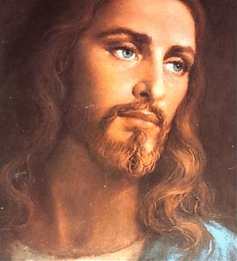
From a theological perspective the idea that the Divine has a racial identity seems ridiculous doesn’t it?  The answer is yes.  But realistically speaking, in our history and lived practice, God has consistently been portrayed as white.   Just try google-imaging Jesus.  What you’ll see is a very European looking dude that looks something like this:

jesuschristhdwallpaper%40sotto2010-blogspot-com%282%29

Yup, there he is, porcelain-white with high cheek bones and maybe even blue eyes.  God himself.  Every time I create slides for a church sermon and search online for images of Jesus to help me communicate, I notice just how common white Jesus is.

Hey wait a second…..

You know what?

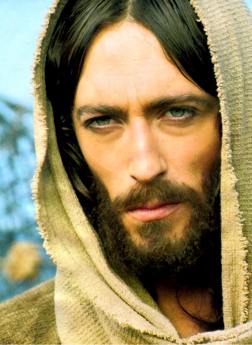
If that guy gained a few pounds, he’d kind of look like me!

screen-shot-2016-09-21-at-12-14-37-pm

And herein lies our massively tragic error.  Western Christianity has made God-incarnate white, an oversight so global in scale that it’s hard to even fathom how severe and terrible the consequences have been and still are.

One story to illustrate.

I’ve been involved with ministry work in Myanmar for the past 12 years and was once invited to speak at a college class for ministry leaders in the city of Yangon.  At the time I was maybe 20 years old and still working on my undergraduate degree.  For some strange reason I was perceived as being respectable enough to speak before this classroom filled with folks from a different culture and whom many were older than I.

Wanting to help, I accepted the offer thinking that I would approach the class lecture a little different.  Instead of teaching on ministry or theology, I would ask questions of the students and create a discussion space to process and learn together.  After a few questions and moments of conversation (I had a translator in case you were wondering), I asked the class what folks who were not Christian thought of Christianity.

Their response revealed a deeper issue.

They said that their family and friends who did not identify as Christian saw Christianity as a white religion.  Christianity could not fully be embraced because it was seen as specifically Western.

In response I tried to explain how this was historically inaccurate, that Jesus actually had more in common with their culture than my own.  I shared that Jesus was technically from Asia, not Europe or North America.  I explained that he likely ate meals while reclining on a rug, lived in a nation that was occupied by the Empire, and did not have freeways, television, or the internet.  Furthermore, his skin tone was probably not like my own freckled and pale exterior, and more like theirs.

I wasn’t getting anywhere.  It felt like I was trying to damn a river with a rope.

Then it hit me.

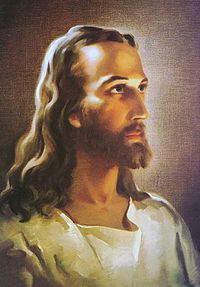
I looked up on the wall behind me and I surveyed this image:

200px-the_head_of_christ_by_warner_sallman_1941

There he was again, porcelain Jesus.  See, in Burmese culture most folks are Buddhist and as a sign of respect and reminder of their sacred tradition, they almost always have a picture or statue of Buddha somewhere on the walls of classrooms or other gathering spaces.  Christians often do something similar by hanging a portrait of Jesus in an important place, and since the context of my “lecture”,  was a Christian classroom, it was appropriate to see this picture hanging there.

Interestingly enough, this specific portrait of Christ was created in 1940 by an American and has become one of the most famous images of Jesus in the world.  Through all my international travel and ministry I can verify that this picture is globally widespread.  Some have even said that this painting has become the visualized image of Christ for hundreds of millions.

While the act of placing a religious image in the front of a classroom isn’t itself problematic, the content of the picture absolutely is.    Why?  Because the painting is historically inaccurate and has been used, whether intentionally or unintentionally, to prop up white hierarchy.

Think about it.  If God is white, doesn’t that say something about whiteness?  Are white folks like me, especially men, closer to God in some way?

As a completely unqualified speaker to that classroom in Myanmar it dawned on me.

I was given a pulpit and authority in part because I look like God, or at least the cast of God that we’ve created in our image.  And if I as a white male have benefited from this globally incorrect portrayal of Christ, how else has this portrayal been used to capture power and authority?

In their book, The Color of Christ, Edward Blum and Paul Harvey discuss at great length this history and the consequences of recreating God as a white man.  They argue that making Jesus more white subconsciously communicates greater value for whiteness and subsequently lesser value for non-whiteness:

“The racial history of the American Jesus shows how the sacred has been racialized and how the spiritualization of race has given notions of human difference not only a life beyond scientific studies or anthropological insights but also a sense of eternal worth” (15)”

So what?

What does it mean for us today that most of our visualized expressions of God look like a European white man?

The unfortunate reality is that white Jesus, when combined with our human tendency towards ethnocentrism and tribalism, and mixed with centuries of European domination of the world, provides the perfect framework for justified oppression and exploitation of others, something that couldn’t be further from the essence of Jesus.  When you start to understand that Jesus was an impoverished middle-eastern refugee who criticized institutional power, embraced the marginalized, and was executed for what we would now call terrorism*2, you realize that porcelain-white Jesus is actually very offensive.  Furthermore, the possibility that white Jesus has in any way propped up- even in the slightest bit- things like slavery, manifest destiny, or white supremacy, should be beyond offensive to anyone who has aligned themselves with his teachings and actions.

That’s why, as part of the healing process with regards to race in America, we must deconstruct white Jesus.

There are many dimensions to modern racism.  As a faith leader, I’m responsible not only to engage this injustice in our societal systems, but also within my own religious tradition.  So here it is:  Jesus was not white.  He didn’t look like me.  His movement was one of downward mobility, surrendering power instead of capturing it.  The message of Jesus disrupted the center and embraced the margins.  As someone who finds himself in the global center, his message should challenge my comforts and draw me into closer proximity with those in need and those subject to injustice.  We have a responsibility to deconstruct the images of Jesus whenever they are used to prop up specific racial identity, exploited for political gain, or used to in any way marginalize people.   All of these appropriations of Jesus completely juxtapose the historical and scriptural accounts of his life and movement.

Here is my point:  Porcelain Jesus is a lie that has tragically been used for the benefit of people like me and at the expense of people of color. This is one of the many elements  of our flawed history that we must address and deconstruct.

*1 Though the subject of racism is awkward, painful, and complicated for me, I do not claim to even begin to know the depth at which it is those things and more to people of color.  I do my best to listen and empathize, but I will never know this struggle.

*2Ok, terrorism might be a little hyperbolic and inflammatory, but he must have done something that made him a perceived threat to the state to be crucified. In fact many argue that crucifixion was not for mere criminals, but for insurrectionists.  Pretty sure a modern day insurrectionist could also be called a terrorist.

.

.

.

.

The Quest for Immortality, the Locale of Meaning, and the Possibility of God

cute-france-memories-paris-photography-favim-com-348666

Just a disclaimer, this post is a little more out there than some of my others. 

An Old Thing

The other day I had lunch at my parents house.  Even though I very much appreciated the sausages and wine, the culinary exploits were not the primary reason I stopped by.  My main purpose that day was to sift through some family photos from my grandmothers house.  In recent years we’ve said goodbye to a couple family members and my parents were now distributing the remaining pictures and artifacts.

As my Dad and I went through a few different bags my eyes clumsily surveyed hundred of snapshots from my own chronology as well as generations of family members’.   It’s always a bizarre, surprisingly emotional (either because the feelings are less or more than expected), and foreign thing to think about people you once knew who are no longer alive.  Something about death just never sits right.  I’m pretty sure you can relate.

Buried inside one of the reusable grocery bags of glossy memory squares I stumbled upon something that I’ve been thinking about all week, something that has seemed to thematically intersect with a few different moments I’ve experienced since then.  Ok, this time I’m a little less sure, but still somewhat confident you can relate to this too- have you ever noticed that sometimes certain themes, ideas, lessons, or words seem to pop up around one another at the same time?  Like from multiple fronts it’s as if you’re meant to consider, ponder, or question something very specific?

This time around the universe seemed to be poking my consciousness through a small leather book filled with handwritten names, sermon notes, and prayers.  As I opened this vintage looking journal I scanned the pages to discover that it was my great grandfathers funeral book.

I guess marking important life or death moments through ritualistic artifacts is still kind of a thing (I’ll get to that), but this book struck me as decidedly from another time.  Flipping through the pages I noticed signatures from each of the people who held the coffin, each funeral attendee, selected passages of scripture, and even the notes from the pastors homily complete with delineated bullet points.  Each of those names represented some one specific that my father’s, father’s, father most likely knew, and at the time it was important to note that they were there.   They were present in that moment, alive, breathing, and apparently they were proficient in cursive.  The impulse captured in that book was in part to mark in space and time the existence of each personality penned on those pages and most prominently the existence of my great, great grandfather.

A New Thing

I mentioned how it felt like some of these ideas were surfacing in my life on multiple fronts, the other one was a familiar voice, Benjamin Gibbard from Death Cab for Cutie.  On their most recent album, Kintsugi, there is a song called Binary Sea which explores some of these notions.  Many of the lyrics touch on the same impulses which drove the creation of that funeral book, and which still drive us today:

“Oh come my love and swim with me
Out in this vast Binary Sea
Zeros and ones patterns appear
They’ll prove to all that we were here
For if there is no document
We cannot build our monument
So look into the lens and I’ll
Make sure this moment never dies”

My interpretation of this verse is that it portrays a couple, either literal or metaphor, that longs to prove that they were here.  However, instead of a signature on a page, they take digital photos to ‘document’ their memory.  Inside those words you can sense the fear of being forgotten, and the longing for immortality though some sort of monument.

This is what we do.  We as humans are desperately trying to prove that we were here.  We’re terrified of being forgotten, haunted by the fear that we might live our lives and not leave a mark, a legacy, or even a memory.  Time is furiously moving us forward, faster and faster still, and we sense the temporal nature of each moment, and so we become creatures that are frantically trying capture and seize the hours at hand before they fade into the past.  We need our lives to mean something and so we transfuse our meaning into things.  Whether it’s photo albums, street names, inheritances, songs, buildings, or accomplishments, we often put our hope in things to capture something about us.  Nowadays we tell our story through facebook timelines and instagram feeds, but the heart is still the same.

So Many Things

Back to my parents house.  As my Dad and I continued scavenging though the stacks of photos, I began to wonder, what do we do with all this stuff?  Can we throw it away?  Would that dishonor the memory of the people who were posing in those pictures?  Should we just hold onto all those newspaper clippings and vacation photos forever, even if we don’t know the significance of their existence as their creators did?

Not only are we driven to mark our existence so that we’re not forgotten, but we do this at an increasing rate, creating a plethora of sentimental items.  Most of these items serve a purpose for a generation, or maybe two, but after that how many of them still carry meaning?

While looking at the names in the funeral book, I wondered what my great grandkids would think of my 1,400 tweets, and seemingly endless feed of instagram and facebook pictures.  Would they even bother to examine all the artifacts I’ve created and collected that prove my existence?

Probably not.  My guess is that in the same way I don’t know what to do so many of the items that I looked through the other day, my descendants probably won’t know what to do with everything I leave behind, even though part of the reason those things were left behind was so that we wouldn’t be forgotten.

The Wrong Things

So if who we are cannot possibly be captured in the things we leave behind, is there something that does?  Yes.  And let me explain by sharing a quick story.

This past Summer we had the chance to travel to Palestine and Israel with my seminary to study and tour the Holy Land.  Dotted across the countryside are countless ruins from bygone eras.  Most notably you’ll find dozens and dozens of complexes built by Herod and his sons.  These buildings were large and in charge, and after a while you get the sense that Herod really wanted to be remembered.  Shoot, he named a bunch of cities after himself too.

At one point my professor took us to a location where Jesus may have been.  It was a small pile of rocks, nothing to write home about.  After explaining the significance of the site, she had us then recount all of the massive structures we’d come across built by Herod.  Then she contrasted these two men by the legacy they left.  She pointed out that though Herod had was a massive builder and loved to place his name on everything, his lasting impact is minuscule compared to that of Jesus, who built nothing, was never published, and never held office.  Jesus’ legacy was passed on through relationships with people, not things.  Which leads me to half of my point.

Relationships are the cradle of meaning for our lives, not things.  They are the space in which we are actually known, and where we can offer meaning to others by knowing them.  Relationships are the space where we matter, and in relationships we mark that we were here.   But relationships don’t last forever, right?

Stranger Things

At some point in time each of the names in that funeral book meant something more than they did to me in that moment.  Each one of those signatures represented a human being, whom, no matter what kind theistic or non-theistic persuasion you might maintain, is universally considered sacred.  And each of those names was an attempt to transfuse our existence into a physical object, thereby creating something from us that will last.  But to me, the other day, they were just names on a page.  They all wrote down their names and notes so that they would not be forgotten, but that’s exactly what has happened, isn’t it?  Or is it?

Here is where things get weird.  In addition to thinking that our meaning comes from relationships, I’ve also got this conviction that reality isn’t an accident and that behind the miracle of life and existence is this thing we’ve come to call God.  One of the claims of this conviction is that God exists outside of time.  And in God time itself collapses and all things are reconciled back to God.  This space is often best described by artistic expression and has been known as the eternal shores, hereafter, heaven, or the great beyond.   Which leads me to the rest of my point.

If relationships are the vessel of meaning for our lives and God exists out of time, than a relationship with God also exists outside of time and is therefore eternal.  See, I can’t prove it, but I lean towards a hope that there exists a space where matter and memories are one and forever.  The language of my faith tradition would call this heaven or communion with God.  The claim of this faith is that no one is actually forgotten and that our value and worth do not come from our accomplishments or the artifacts we create in search of immortality, but rather in relationship to others and to God.  If relationships are the locale of actual meaning in our lives, than what does it mean to be in relationship with a God?

I think it means that every moment and memory we experience while alive is not lost to history after our bodies wear out, but actually lives on forever because God is beyond time.  The sheer joy of hearing your child laugh for the first time, it’s still happening in God.  That time we watched in awe as the sun set over the ocean, God is there, and we will soon be too.  The first kiss on your wedding day that was captured by a photographer and now lives in an album on your IKEA bookshelf, God’s still there, and we will be back there someday.  All of the memories and experiences, both high and low, are redeemed and brought to communion with the eternal.  Each of those names in that funeral book is some one loved by God and though forgotten by most of us, potentially now in a space more alive than ever before.

So there you have it, some thoughts on immortality, God, and things.  I know that all might sound a little abstract, overly hopeful, and maybe even a little mystical, but that’s what’s been marinating in my mind thanks to that funeral book and that song lyric.  What strange ideas or life lessons seem to be surrounding you?

.

.

.

.

>
Book Review: Grounded, Diana Butler Bass

Diana-Butler-Bass-cover-of-Grounded-Finding-God-in-the-World

If there is a possibility that the divine can be encountered or known in some way, what is the context for this exchange?  Is it an intellectual pursuit?  Does it happen within a spiritual, religious, or ascetic practice?  What is the terrain, the location, or the neighborhood in which God’s story intersects with humanity’s?

These are the questions that Diana Butler Bass seeks to answer in Grounded: Finding God in the World- A Spiritual Revolution.

I first encountered Dr. Bass when I read A People’s History of the Christianity, which tells the story of Jesus’ movement from the perspective of the radicals,  misfits, and those on the margins of power and institution, and I felt a deep resonance with her writing and sense of God.  So when heard about Dr. Bass’ most recent effort, I was excited to immerse myself again with her writing.

The main premise of the book is that the spiritual life is not disconnected from everyday life, nor is God found only at the top of our religious expressions, but that God is near, grounded in our midst.  This differs from the ways God has been talked about for much of our history, because we’ve often either intentionally or unintentionally claimed that God can only be encountered within church and religion.  Furthermore, faith communities have often unconsciously communicated that they own the market on “God experiences”.

What Dr. Bass explores is the opposite idea, that God is often more understood outside of our religious communities.  She describes how much of our most sacred faith stories actually happen while people are walking, talking, and living.  Most of the Jesus stories captured in the gospels take place in everyday life, with every day people. Of this shift in perspective Dr. Bass says in one interview, “Being in nature and being in the neighborhood made the Bible come alive in new ways and relocated God to me.”

Neighborhood and nature.  That’s where we often experience of God.

Then why go to church?  Why do religion?

Dr. Bass would argue that the church is the place where these experiences can be embraced, celebrated, encouraged, and shared in community.    The church’s role is to wake people up to the presence of God not only in our congregations, but also in neighborhood and nature.  Without being grounded in a community that grounds us in God’s presence everywhere, we may miss it.

I totally agree with Dr. Bass’ musings because the places I often sense God the most are in the faces of those around me, and in the gentle breeze and scenery of my surroundings.  I think this explains why for so many people, considering themselves spiritual but not religious makes more sense than aligning themselves with institutions that have such tarnished histories.  But as much as the temptation to enter into spirituality alone is strong and enticing, the reality is that we cannot do it alone.  The downside of pursuing the spiritual in isolation is that we completely miss out on the rich history passed down through the centuries of those who have walked the path before us as well as a place to meet the innate human need for community.

In this way Dr. Bass’ book is a beautiful depiction of how we can embrace God’s presence outside of the church, but not without the church, for the church is the collective of communities experiencing together the God who is near and is the “ground of being”.  For anyone who is looking for a spiritually stimulating read that has the potential to re-frame how you see nature and neighborhood, I can’t recommend Grounded enough.

Below you’ll find some of my favorite quotes from the book:

“We live and move and have our being in a great web of belonging whose connective tissue is grace.”

“Much to my surprise, church has become a spiritual, even a theological struggle for me. I have found it increasingly difficult to sing hymns that celebrate a hierarchical heavenly realm, to recite creeds that feel disconnected from life, to pray liturgies that emphasize salvation through blood, to listen to sermons that preach an exclusive way to God, to participate in sacraments that exclude others, and to find myself confined to a hard pew in a building with no windows to the world outside. This has not happened because I am angry at the church or God. Rather, it has happened because I was moving around in the world and began to realize how beautifully God was everywhere: in nature and in my neighborhood, in considering the stars and by seeking my roots. It took me five decades to figure it out, but I finally understood. The church is not the only sacred space; the world is profoundly sacred as well. And thus I fell into a gap – the theological ravine between a church still proclaiming conventional theism with its three-tiered universe and the spiritual revolution of God-with-us.”

“For millennia, land was the beginning of faith: gratitude for it, struggling with it, reflecting upon it, recognizing its power, fearing its loss, or seeking its increase. Without the long human relationship with the soil, there would be no great cycles of feasts and fasts, no appreciation of ritual foods, no practices of tithes and thanks-givings. Indeed, the God we know—as well as the God we hardly remember—is the Spirit of the Soil.”

“The Milky Way, the Northern Lights, constellations of north and south, millions of distant planets and moons and suns and comets, all dancing in the dark to some primal pattern that physicists seek and poets extol.”

“With oil, coal, and gas as our bricks, humanity has built a carbon tower of Babel, now poised to crash down.”

“Home is more than a house.  It is a sacred location, a place of aspiration and dreams, of learning and habit, of relationships and heart.  Home is the geography of our souls. The “where questions of home naturally open to the spiritual question: Where is God?”

“The church is not the only sacred place; the world is profoundly sacred as well.”

“The earth, covered with red dust (Hebrew adamah ), is not a generative and hospitable place, because there is “no one to till the ground.” So God causes springs to come up from the earth itself, makes a clay, and forms a man ( adam ) from the ground. God breathes into him, and gives life to this “soil creature.” God places Adam in the garden, to grow it and to care for the rivers and plants and animals, and eventually draws Eve ( havah , meaning “to become,” “to breathe,” or “life”) from Adam’s body to be his partner. Thus, Adam and Eve, not a literal first couple, but rather Soil and Life (their “names” from the Hebrew words) marry, and their union produces the human race.”

“God, the spirit of wonder, or Jesus…”

God is “… gracious mystery, ever greater, ever nearer.”

“A Stanford University researcher analyzed fMRI results and found that engaging nature stimulates the same area of the brain as does food, sex, and money. Studies in Europe and North America continue to show that either viewing nature or engaging in outdoor sports, especially when involving oceans, lakes, or rivers, calms us and elevates positive emotions. It also promotes attentiveness, concentration, and creativity. 10 In addition to steadying human emotions, being near water has proved to have curative effects on many health problems, including PTSD, depression, addictions, autism, pain, anxiety, stress, and attention disorders, and to hasten healing from surgery, illness, and injuries. As marine biologist Wallace Nichols observes, “Nature is medicine; this is an idea now reiterated by modern science.”

“That it is precisely when we recognize our common humanity—when we recognize our own humanity in the face of the other—it is then that we also recognize the face of God.”

.

.

.

.

.

.

.

‘Consider’ and Other Clues to Being Fully Human.

Screen Shot 2016-08-06 at 11.37.25 AM.png

Photo cred @beholdcreators from @oaklifechurch #didyouseefeel Lent project


Have you ever noticed that throughout our language, culture, and sacred traditions are countless clues that point us toward something more?

Picasso said “Art is a lie that reveals the truth”.  In those words the famed artist encapsulated the idea that our created works often offer us sign posts that point us down the path of a less veiled reality.

In my experience this is true of so many things beyond art.  Sure, our films, songs, and literature often have deeper meanings woven throughout them, but I think the line between art and non-art is more blurry than we may think.  Things like architecture, clothing, food, transportation, and sports are all teeming with hidden messages if you take the time to notice.  There are symbols everywhere, offering us clues to wake us up and that reveal to us things of ever greater importance.  This is part of being human, the journey of  finding meaning and passing it on.  I guess the question is, are we paying attention?

Which brings me to a “clue” I discovered this morning.

Specifically, I learned that the word ‘consider’ comes from the Latin word considerare which is literally translates to “observe the stars”.

There it is, hidden in the essence of a commonly used word,  a picture of being human that goes way beyond a few syllabic utterances and deeper than a brief definition.  In reality, the word consider is a poetic portrait of what it means to be uniquely human, namely the gift of being able to behold our existence with awe and wonder.

As a city dweller I often neglect and even forget the stars.

What a tragedy.

It’s a tragedy because I’m missing out on something so beautiful and amazing.  Each night, just above our heads, the cosmos dances about, teasing us with mysteries science has only just begun to unravel.  If only we’d stop to consider in a way that honors the heart of that word.  If only we’d pause in life more often and notice the beyond-words reality that we’re spinning around on a pale blue dot in the middle of a seemingly infinite multitude of planets, stars, and empty space.

As I mulled over the image captured in the word ‘consider’ I found myself remembering two instances where this linguistic truth-clue appears in the sacred text of my particular sacred tradition:

First in the book of song, prayer, and poetry (worship) we read:

When I consider your heavens,
    the work of your fingers,

the moon and the stars,
    which you have set in place,
what is mankind that you are mindful of them,
    human beings that you care for them?
Psalm 8:3-4

Here the author seems to get it, the fundamental act of “observing the stars” which then leads to a sense of smallness and cosmic perspective.   I’ve been there.  When I look out at the oceans or the sky, I sometimes find myself asking the same question, “In the midst of the cosmos, who am I?  Why, God, would you care about me?”  That feels like an important question, where in the answer we find ourselves caught between the mystery and intimacy of the divine.

The other place this concept fired a memory neuron in my mind was from the book of wisdom, also known as Proverbs:

Go to the ant, you sluggard;
    consider its ways and be wise!
It has no commander,
    no overseer or ruler,
yet it stores its provisions in summer
    and gathers its food at harvest.
Proverbs 6:6-8

The human act of considering is not only directed towards the galaxies, but also towards the smallest of things like ants!  I remember being mesmerized by ants as a kid, following their trails and being amazed at how they knew where to go even if I closed up their ant-hole or blocked their way.

Here is the point.

All around us, all the time, with every breath, is wonder, beauty, and miracle.  Our sacred traditions, our ‘lying’ artwork, and our linguistic libations are all offering us clues.  Living a life rhythm where this pursuit is embraced is the clue I discovered today in a simple word, consider, which is not that simple after all.

What clues are you noticing today?

How can we really consider the worlds around us in a way that is truer to the word’s meaning?

.

.

.

.

.

The paradox of how to address G-D

Screen Shot 2016-07-29 at 3.28.54 PM.png

Photo cred @beholdcreators from @oaklifechurch #didyouseefeel lent series

I recently had a conversation with some one about the concept of God.  God is this idea that things are created and that there is some sort of being above and beyond all of reality.  The friend that I was talking to used to have a very thought out understanding of this God and how God operated in relationship to our world.  But then through life circumstances, both the highs and lows, they saw the finish and veneer of that deity-portrait begin to fade and crack like a centuries old piece of art.  The words and ways through which they knew God just didn’t seem to be holding water any longer.

In our culture, God is largely filtered through our language, which is inherently sexist in that it operates in a binary, specifically male/female language.

But does the Cosmic Cause and Source of All have a gender?

It’s complicated.

The more I read from the wisdom and imagination of folks who have spent their life trying to listen to and understand God, the more I realize that God is inherently other (holy).  God is beyond our categories and transcends all language, art and metaphor.  This is why in many traditions like apophatic theology, God is described by realizing what God is not. Essentially as soon as you find words to help us understand God, you must unsay those words, because they could never come close to fully encapsulating the divine.  This is also why in Hebrew tradition, which all Christendom is indebted to,  God’s name is not even spoken or written.  With this sentiment an author I’m currently reading  ambiguously identifies God as, “gracious mystery, ever greater, ever nearer”.

So yeah, God is beyond what our brains can cognitively hold.  But there is another angle to this as well.

The same God who is beyond my potential comprehension…..

Is also, somehow, deeply personal.

This same God comes near to us, and is talked about in intimate terms like “Daddy” or “Father”.  This God suffers with us, enters into our mess, and promises to never leave us or forsake us.

So there is tension.

On one hand, God is beyond, but on the other hand God is nearer than anything or anyone.  And so I find myself trapped.  I mentally know that using masculine language to describe God is inaccurate, but I can’t help but use the words that are at least somewhat closer to what my spirit tells me God is: with me like a unconditionally loving parent.

Sometimes when I look up at the stars or hear some beautiful music, I feel a sense of wonder and awe that we even exist and that we are privileged enough to behold life.  In those times God can’t possibly be named or captured with my words.

Other times God is crying right beside me, helping me carry the burdens I’m weighed down by, and even though I can’t explain it, He is near, and He is a loving Father who knows me intimately and deeply.

So like many things with the life of faith, there is paradox.  Two seemingly mutually exclusive truths, both as true as possible, at the same moment.  God can’t possibly but be named, yet God is Abba.

How do you describe/sense/understand/know/un-know this thing we call God?
What words, songs, feelings, movements, pictures, sensations, titles, help you walk through the mystery of faith?

.
.
.
.

.
.
.
.
.
.
.


Hope is A Mile and a Half Away

Screen Shot 2016-07-03 at 7.01.18 AM.png

Banksy Mural on wall between Israel and Palestine.

Every week it seems like there has been some sort of heartbreaking event streaming though my facebook feed, on the news, or in our communities.  Unjust killings, racial conflict, wars, and terrorist attacks have become as familiar as the checking the email. Where is it all heading?  What’s next?  Is it going to get worse or better?

Last month I had the unique opportunity and privilege to travel to the Palestine and Israel with my grad school, Fuller.  The trip was part academic, part pilgrimage, and part geopolitically informative.  To stand in the space where some of the most historically tectonic events occurred was powerful on multiple levels, and it was here that I heard some words which connect to our current reality and that have been bouncing around my insides since we returned.

As a junkie of global politics and current events (I fall asleep listening to the news each night- weird, huh?), one of the most captivating aspects of our travels was getting a glimpse into the conflict between Palestine and Israel.  This specific location is the nerve center at the root of much of the global divides we face today.  It’s in this land that one can witness the affects of colonialism, globalization, fundamentalism, religiosity, as well as historic ethnic, political, and spiritual divides that run millennia deep.  On our tour we had the chance to learn from Rabbis for human rights, Israeli teachers, and also a few Palestinians.  And it was the perspective of one Palestinian professor and faith leader that left the greatest impact.

His name is is Munther Isaac, and we had the random chance to hear him share about his work and viewpoint at the school he teaches.  Beyond the wall that divides Israel from Palestine, in the city of Bethlehem, in what feels like an underdeveloped and impoverished community when compared to those on the the other side, Dr. Isaac invited us to ask some questions after his time of sharing.

I raised my hand and asked the questions I asked earlier, but tried to sound smart and “academic”, this was a graduate school sponsored tour after all.

“Pragmatically speaking, not hopefully, what do you see happening next?  Where is the conflict between  Palestine and Israel heading?  Will it get worse or better?”  I asked.

Dr. Isaac responded (this is a paraphrase, but very close to what he said), “Pragmatically, given the lack of accountability on the side Israel, the continued illegal settlements in the Palestinian territory, the extreme worsening conditions for Palestinians, I see things getting worse, potentially leading to a larger conflict.”

There it was, right before our ears.  An incredibly educated and deeply connected leader admitting the unfortunate reality that things seem to be getting darker and more divided. Given all that we learned about the conflict, the history, and the failure of reconciliation for decades, it’s a logical prediction.  But Dr. Isaac didn’t finish his answer at that point, he went on:

“But one and a half miles that way (pointing to Jerusalem), Christ rose from the grave.  So I have hope that things can change and that we will overcome these current difficulties.  If I did not I would not be doing what I do.”  He finished.

Boom.

As a person of faith there is always a claim of hope that things can get better.  Since finding my way into my beliefs (or maybe they found me) as a young man I’ve heard this message countless times, but seeing a man who’s giving his life for the sake of peace and justice passionately point to a literal location, within walking distance, where the impossible became possible, carried a completely different weight to say the least.  From where I sat, I could look out the window and see the skyline of Jerusalem, the place where resurrection happened- like, really happened.

The main thesis of the Christian tradition is that love wins- that’s resurrection.  It’s a counterintuitive and illogical proposal that calls us to live into hope even if things don’t look so good.  Given all that’s going on in our world at this time, this is a message I think we all need.

Let’s not get weary.
Let’s not give up.
Let’s not settle.
Let’s not live out of defeat, but out of hope.
Let’s continue to work towards mercy, justice, reconciliation, and love in our lives, our families, our communities, and in our world.

What struggle do you face?
What tragedy has given you despair?
What if resurrection happened a mile and a half away, how would that change the narrative of defeat and tragedy in our world?

Like I said, those words are still bouncing around my insides, so I thought I’d share.

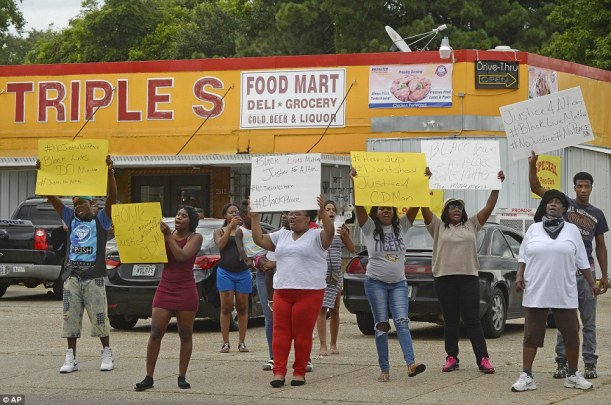
To my friends and family: It’s real, #blacklivesmatter.

35FDDFDA00000578-3677156-Family_and_friends_of_Alton_Sterling_protest_in_the_parking_lot_-a-87_1467819789123

However you identify politically, religiously, socially, or ideologically, there is no denying that the sentiment among the black community in America is one of deep mistrust of law  enforcement, still open wounds from centuries of oppression and slavery, and a tangible fear of all kinds of unjust treatment (based on lived experience and statistical reality).

I often think about the time a friend of mine who happens to be pastor in a mostly white context told me that she thanks God that her kids are girls and not boys because she’s scared that if she had had boys, there would be a realistic chance that they would be killed by the police.  Her experience is not isolated, and is a perspective I not only trust, but look up too.

As a white male I have never once felt that my life would be threatened by the police, even though I’ve done some pretty stupid stuff in my time.  When I think about having kids, I’ve never once had a fear of them being boys.  As I watched and read about the horrific killings of Alton Sterling and Philando Castile, their experience felt like worlds away from my own.  As a white person, many of us have a built in sense that we can trust police officers, and that these fallen image bearers of God must have been in the wrong in some way.

But then you watch the videos again.

And then you reflect on the experiences of your black friends.

And then you read the Facebook posts.

And then you pray.

And then you listen to the stories.

And then you read the statistics.

And then it happens again.

They didn’t deserve it, and it keeps happening.

And it’s not just the killings.

It’s the racist texts, the trafficked minors, the unfair profiling, and more.

It’s real.

As a Jesus follower and faith leader, I’m reminded of the words of St. Paul who, in the context of living lives of worship and love, tells us to “mourn with those who mourn”.

So to my African American friends who are devastated yet again by the killing of another soul at the hands of law enforcement, I am devastated with you.  I hear you.  I know I cannot fully understand all that you must be feeling, but I’ll do my best to try.  You have my ears, my voice, and my actions.  I will use whatever privilege I have to be an ally.  You matter.

To my friends who just don’t see it yet, I have a heartfelt request of you.  Would you consider moving closer to the pain of our African American sisters and brothers?  Without trying to filter who’s right and who’s wrong, would you just listen to their perspective?  Would you put yourself in their shoes and try to imagine the history and the current reality?  The pain is real, the wounds are deeper than you can know, and the need for justice is severe.

To my friends in law enforcement, thank you for doing an incredible hard job at a time like this.  We pray for your protection and that you can be a force for good, coming against injustice.

To my friends in the faith, if you’ve oriented any part of your life around Jesus, would you consider following his example by moving towards the pain of others and towards the marginalized and voiceless?

It’s real.  Things are broken. There is no denying it.  The question for us in this becomes, what does love obligate us to?

Tonight I’ll be joining Pastor Ben McBride among other faith and community leaders at a local rally.  Feel free to join:

https://www.facebook.com/events/1634114356903873/

……..article-alton1-0705

Gender Hierarchy and the Struggle to Own Priviledge.

Symbol for women and men.
I’m going to try and have a post about two potentially different topics- proceed if you’re feeling courageous:

On any given day I’ll see dozens and dozens of different conversations on social media.  I tend to stay out of most threads because I don’t find them particularly productive.  Usually folks just dig their heels into their own opinion without empathetically trying to understand what others are arguing for.

Yesterday I jumped into a discussion that I’d like to share.  It started when I saw a post from an old acquaintance and read through some of the subsequent comments.

This thoughtful person had just had a conversation with a man who believed that the men are better than women, and that this was ordained by God in some way.   Curious what others thought, my friend asked their Facebook friends to chime in, especially those who  believe in God.  They also posted a video in which a religious leader was preaching about the responsibility of men to control women.

Reading through the comments it was clear that my opinion as a white male could easily be grouped with “colonialists” and European patriarchal systems, so I did my best to preface my thoughts with a disclaimer.

I’m sharing this for a few reasons.  First, because I think that the idea of gender a hierarchy is straight up wrong and I’d like that to be known beyond just an obscure FB thread.  Second, because I’ve been wrestling for some time now with what it means for me to share my convictions given who I am.  For many of my white friends, we struggle with our white privilege and often feel like our voice isn’t valid.  While I do think that privilege should be struggled with in substantial ways, I wonder if instead of becoming silent altogether, we can learn new ways of voicing our ideas?  I’d love to get any feedback from friends to see how this came across.   Is it too much or not enough?  Am I off base? Should I not have chimed in at all?

So here is my post regarding whether or not I think men are superior to women and should have control over them.  It was mostly well received I think:

“As a white male I know and understand my voice should be placed in the context of privilege and I fully acknowledge that people who have had my skin color over the centuries have been the primary (though not only), force of oppression against brothers and sisters who look/believe/live differently. So, I know that right off the bat my perspective is problematic, and I repent and ask forgiveness before I share anything.

With that said, and since you asked, as a Christian Pastor who’s studied culture and theology, I do not believe that hierarchy between genders is part of the “kingdom” that Christ is moving us towards. I can’t speak in depth about other faiths, but I can share about mine.

The idea that men are above women is based on generations of patriarchy, which is found in every culture around the world, and is an abuse of biological differences between the roles males and females have played in society. Because men have evolved with testosterone, men develop different kinds of bodies that make them stronger in the physical sense than women. Given that human nature has a strong tendency to act out of selfishness and insecurity (fear of not being in control), men have taken the physical strength advantage and used it to oppress and control women. Subsequently we have looked to faith traditions, which are often birthed in patriarchal cultures and found passages that teach that men are above women to back up our sexist and patriarchal views (this seems to be what your friend has was arguing for and also what Farakhan and many others do as well). In my view this grieves the heart of God.

Galatians 3:28 says that in Christ there is “neither Greek nor Jew, male nor female, slave nor free.” This means that the hierarchies and divisions we’ve created are illusions. Furthermore, science is telling us that gender is not a binary, but more of a spectrum meaning that male and female are not really always black and white categories. So what would some one who argues for hierarchy say to a hermaphrodite? Are they below or above women and men? Or how about a masculine woman or a feminine man?

So I believe that my faith tradition teaches mutual submission where we are all loving and serving one another as equals. This is egalitarianism- which is what my wife and I also practice in marriage.

Also, I think the impulse to control anybody and anything is scary. In Christian tradition the call is to give up control, to surrender, to find life by giving it up- so anytime I hear men say that they should “control” others I’m pretty sure they are being more informed by a desire for power than Jesus.

Just my thoughts.”

.


.

.

.

d